Microgrids
What is a Microgrid?

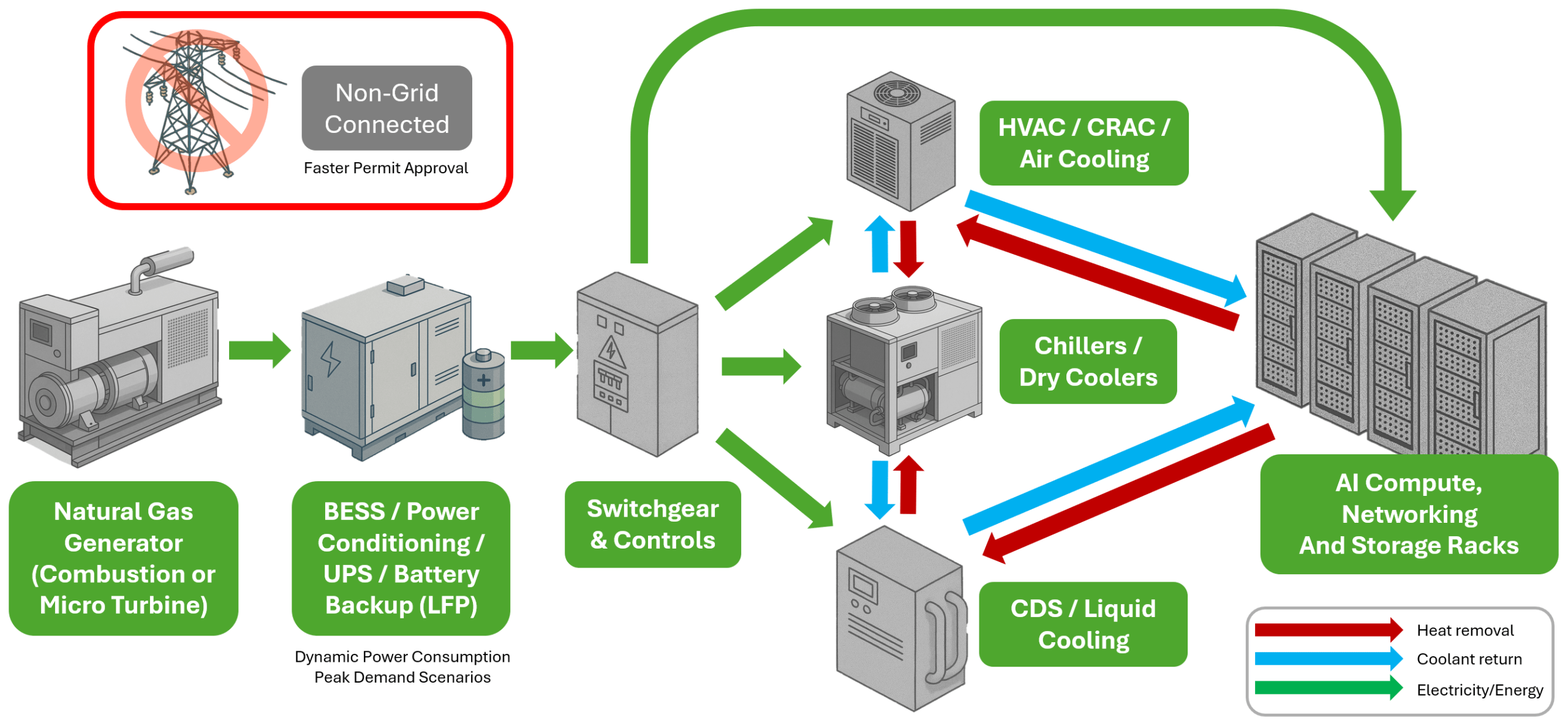
A microgrid for a data center is a localized power-generation, energy-storage, and distribution system designed to provide reliable power for high-density compute. It can operate independently from the utility grid or be configured to complement available utility power, depending on the customer’s requirements.

Microgrid equipment solutions from MG4AI can include:

1. On-site generation: Natural-gas generators, including microturbines, reciprocating generators, and other generation technologies selected for the project requirements.
2. Energy storage systems: BESS configured for resiliency, transient response, ride-through, black start, power quality, and other project requirements.
3. Advanced controls: Control systems supporting generation, BESS, load management, redundancy, system response, and overall power coordination.
4. Switchgear: Electrical distribution and protection equipment configured to safely deliver power from the generation system to the customer’s facility infrastructure.
5. Power distribution: 480 VAC or 800 VDC distribution strategies designed around the requirements of the customer’s compute pods, data halls, and AI racks.

Microgrid Diagram
MG4AI-supplied microgrid equipment can help a data center:
Generate dedicated on-site power (non-grid tied)
Eliminate dependence on the utility grid
Increase power resiliency and infrastructure flexibility

Why Microgrids Are Critical for AI Data Centers:

AI Power Demand Is Growing
New generations of GPUs and AI systems continue to increase rack power density. As compute environments scale, the required generation, electrical distribution, energy storage, and cooling infrastructure must scale with them.
  • AI racks require significantly more power than traditional enterprise compute.
  • New GPU platforms are driving increasingly dense power and cooling requirements.
  • Large AI deployments can require tens or hundreds of megawatts of dedicated capacity.
Utilities Are Constrained
In many markets, sufficient utility capacity may not be available within the customer’s desired deployment schedule.
  • Available utility capacity can be limited in high-growth data center markets.
  • Utility upgrades and new interconnections may require substantial lead time.
  • Behind-the-meter generation provides another option for customers evaluating how to obtain the power required for AI compute.
Power Availability Enables Deployment
AI compute cannot be deployed until adequate power and cooling infrastructure is available. Behind-the-meter generation can provide customers with an alternative path to evaluate when utility capacity or timing does not meet project requirements.
  • Power availability is a critical factor in AI infrastructure planning.
  • Modular generation allows customers to align power capacity with phased compute deployment.
  • Additional generation and cooling equipment can be added as infrastructure requirements increase.
Resilience and Uptime
High-density AI compute requires a power architecture designed around availability, resiliency, and rapid changes in electrical load.
  • On-site generation can provide primary or supplemental power.
  • BESS can support ride-through, transient response, black-start, and other resiliency requirements.
  • Redundant generation and modular power blocks can be configured around the customer’s required availability objectives.
Why This Matters in the AI Era:
  • No power = no AI infrastructure = no revenue.
  • Behind-the-meter generation resolves utility capacity shortfalls.
  • Modular generation, BESS, and cooling can scale with compute demand with MG4AI solutions.